跳至内容
跳至内容 

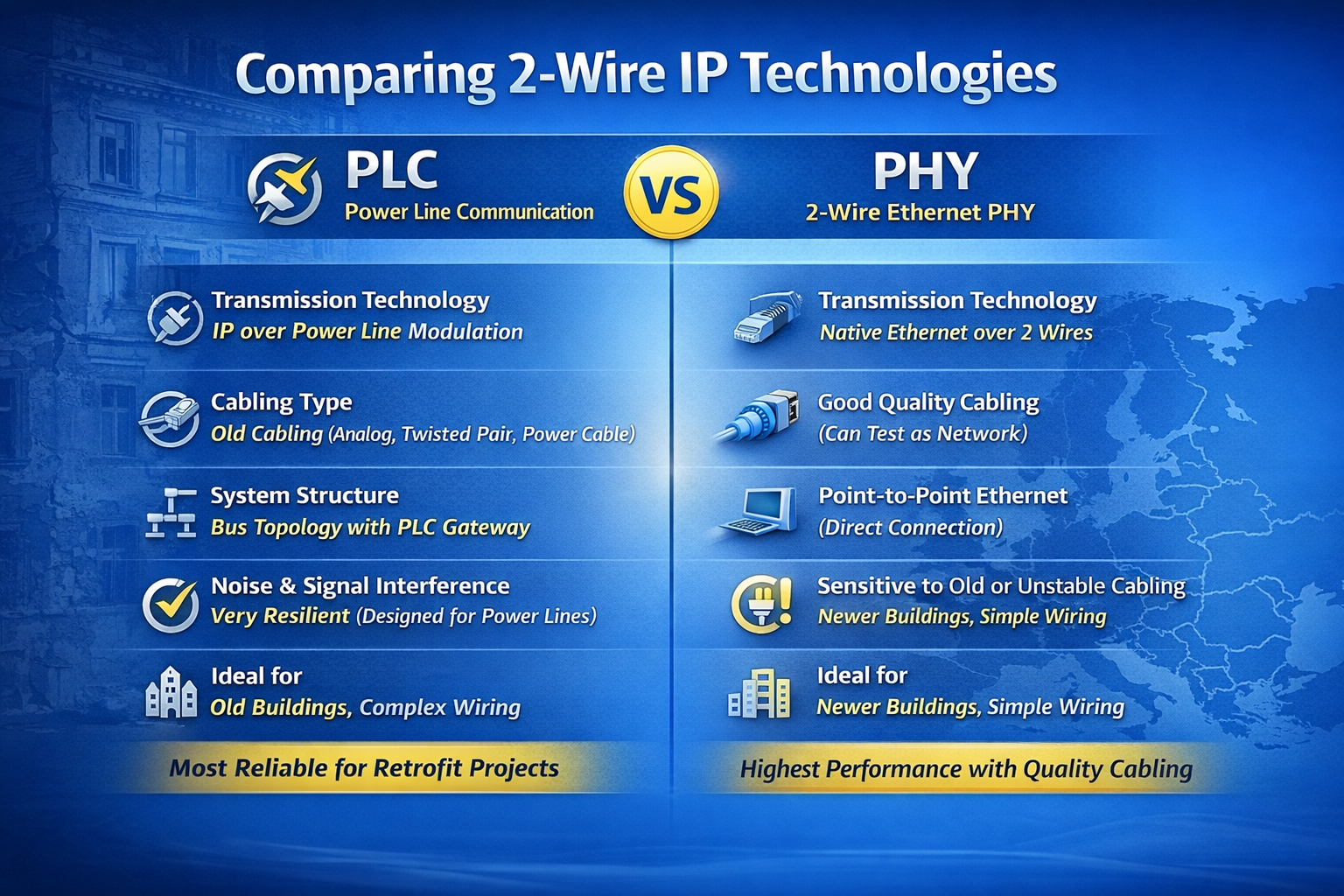
After understanding the basic concept of 2-Wire IP systems and the technical differences between PLC and PHY, the next question is simple:
Which solution should you choose for your project?
There is no universal answer. The right choice depends on the building type, system size, and long-term expectations.
This article provides a clear and practical decision guide for importers, installers, and project-based buyers.
Step 1: Start with the Building Type, Not the Product
The most common mistake buyers make is starting with product specifications.
Professional buyers start with the building scenario.
Ask this first:
- Is this a villa or a multi-apartment building?
- Is this a new project or a renovation?
- Will the system need to expand in the future?
These answers will already narrow down your options.
Villa and Small Residential Projects: When PHY Can Be Enough
For single-family houses or small villas, system requirements are usually simple:
- One door station
- One or two indoor monitors
- Short cable distance
In these cases, PHY-based 2-Wire IP systems can be a reasonable choice.
Their advantages include:
- Lower initial cost
- Simple system structure
- Fast installation
If the project:
- Has no plan for expansion
- Does not require BUS wiring
- Accepts point-to-point or hand-in-hand wiring
Then PHY can meet the basic needs.
However, buyers should clearly understand its device limit and wiring dependency before making a decision.
Apartment and Multi-Tenant Buildings: Why PLC Is Preferred
Apartment buildings introduce very different requirements:
- Multiple indoor monitors
- Shared wiring paths
- Longer cable runs
- Ongoing maintenance
In these scenarios, PLC-based 2-Wire IP systems offer clear advantages.
PLC systems are designed for:
- True BUS wiring
- Multi-device communication
- Better fault tolerance
If one indoor monitor fails, others continue to work.
This is critical in buildings managed by property companies or housing associations. For projects where stability and scalability matter, PLC is usually the safer long-term choice.
Step 2: Consider Future Expansion, Not Just Today’s Needs
Many projects start small like one building from one phase.
Later, the same system may need:
- More indoor monitors
- Additional entrances
- Integration with access control
This is where the technology choice becomes visible. PHY systems often reach their limit quickly.
Expanding them may require converters, additional wiring, or system redesign.
PLC systems, on the other hand:
- Are designed to support more nodes?
- Allow phased expansion?
- Reduce rework costs?
For B2B buyers, this flexibility often justifies the higher initial price.
Step 3: Evaluate Engineering Risk and Maintenance Cost
Initial product cost is only part of the equation. Professional buyers also consider:
- Fault isolation
- Maintenance time
- After-sales service cost
In point-to-point or daisy-chain systems, one faulty device can affect others.
This increases troubleshooting time and service visits.
BUS-based PLC systems reduce this risk.
Each device works independently on the same line. Over the life cycle of a project, this difference has a real cost impact.
Do PLC Systems Always Need 2-Wire Switches?
This is a common concern. In many low- and mid-rise apartment buildings:
- PLC systems can operate with direct BUS wiring
- No additional 2-wire switches are required
In larger projects, switches may be used to:
- Improve signal management
- Segment large networks
The key difference is In PLC systems, switches are optional optimization tools, not mandatory expansion devices. This gives installers more flexibility in system design.
Step 4: Match the Technology to Your Business Model
Technology choice is also a business decision.
Importers and distributors benefit from scalable systems that can serve multiple project types.
Installers prefer systems with lower fault risk and easier maintenance
Online sellers need clear positioning to avoid misunderstanding
PLC-based systems allow broader application:
From small apartments to large residential buildings
PHY-based systems are more limited but can be competitive in specific niches.
Final Recommendation: Choose with Clarity
Both PLC and PHY have their place.
Choose PHY for:
- Villas
- Simple residential projects
- Cost-sensitive installations
Choose PLC for:
- Apartment buildings
- Retrofit projects
- Systems requiring BUS wiring and scalability
The most important step is understanding the difference before purchasing. A 2-Wire IP system should not only work on day one. It should continue to work as the project grows.
In professional projects, the best system is not the cheapest one.
It is the one that remains stable when requirements change.