跳至内容
跳至内容 

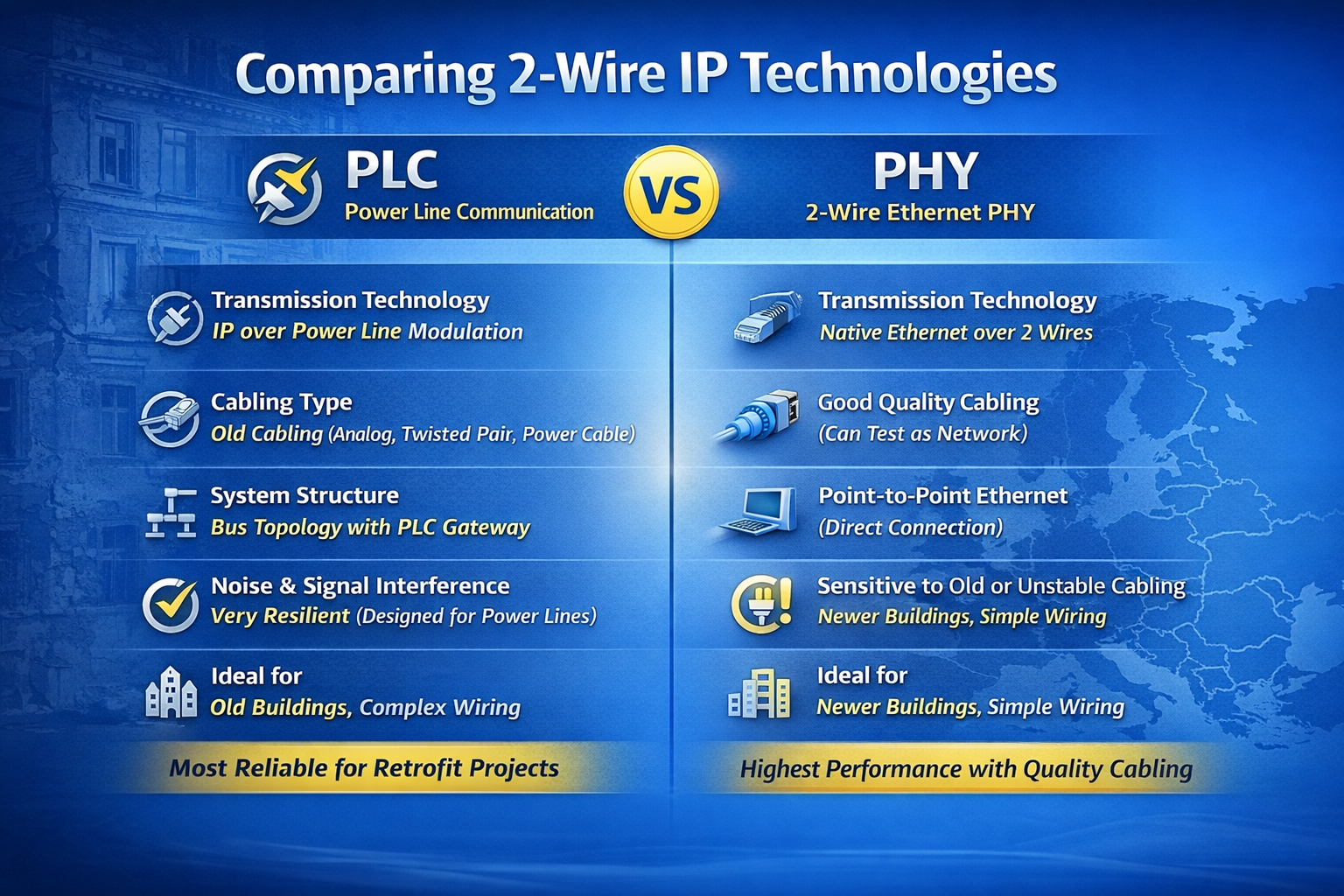
In last article, we explained that not all 2-Wire IP video intercom systems are built the same. PLC and PHY may look similar on the surface, but their system behavior in real projects is very different.
In this article, we focus on what really matters after installation:
- Wiring structure
- Expansion limits
- Fault impact
- Long-term maintenance
These are the factors that decide whether a system stays stable or becomes difficult to manage.
BUS Wiring vs Point-to-Point: A Fundamental Difference
One of the biggest differences between PLC and PHY is network topology.
PLC technology naturally supports BUS wiring.
This means:
- Multiple indoor monitors can share the same two-wire line
- Devices work in parallel, not in a chain
- Cable routing is flexible
For installers, this is critical in apartment buildings:
- Easier planning
- Less dependency between devices
- Better tolerance for wiring variations
- BUS wiring is especially suitable for:
- Multi-tenant buildings
- Renovation projects
- Systems that may expand later
PHY: Point-to-Point at Its Core
PHY-based systems are different. Most PHY implementations are:
- Point-to-point by design
- Or rely on hand-in-hand (daisy-chain) wiring
In practice, this means:
Indoor monitors must be connected in series
One device depends on the next
Some manufacturers introduce 2-wire converters or switches to simulate BUS behavior. However, this adds:
- Extra hardware
- Extra cost
- Extra failure points
Node Failure: What Happens When One Device Goes Down?
This is a real engineering risk that is often overlooked during purchasing.
In PHY Systems, When devices are connected in series:
- One faulty indoor monitor
- One loose terminal
- One damaged cable
In apartment projects, this creates serious problems:
- Difficult fault isolation
- Longer maintenance time
- Higher service cost
For installers, it also means:
- More site visits
- More complaints
- More pressure from property managers
In PLC Systems
PLC-based BUS systems behave differently.
Each device communicates independently over the same line.
If one indoor monitor fails:
- Other devices continue to work
- The system remains online
This fault tolerance is a major reason why PLC is preferred in:
- Large residential buildings
- Social housing projects
- Long-term managed properties
Scalability: How Many Devices Can the System Really Support?
This is where PLC and PHY show their clear difference.
PHY: Limited Device Count
Based on current market implementations:
- Most PHY systems support 1 door station + 1 indoor monitor
- Some villa-focused solutions support 2 indoor monitors
- The upper limit is usually 3 devices total
This makes PHY suitable mainly for:
- Single-family houses
- Small villas
- Very simple installations
Trying to scale PHY beyond this often requires:
- Additional converters
- Complex wiring
- Careful signal balancing
PLC: Built for Multi-Device Networks
PLC technology is designed for multi-node communication.
In real projects, this allows:
- One door station
- Dozens of indoor monitors
- True apartment-level scalability
This is why PLC is widely used in:
- Multi-apartment buildings
- Mixed residential-commercial projects
- Phased installations
Do Apartment Projects Need 2-Wire Converter Switches with PLC?
This is a common and very practical question. The answer depends on project size and layout.
In many low- to mid-rise apartment buildings:
- PLC systems can work with direct BUS wiring
- No extra 2-wire switches are required
- For larger buildings or long cable distances:
PLC switches may be used to
- Segment networks
- Improve signal stability
The key point is in PLC systems, switches are used to optimize, not to enable the network.This is very different from PHY systems, where converters are often mandatory to expand the system.
Long-Term Maintenance: The Hidden Cost Factor
From a B2B perspective, long-term cost matters more than initial price.
PHY systems may offer Lower entry cost and Simple structure for small projects
But as soon as more devices are added, the building layout becomes more complex, the maintenance is required and its limitations become visible.
PLC systems usually cost more upfront.
However, they offer better stability, easier expansion and low after-sales risk. For professional buyers, this trade-off is often worth it.
Choosing the Right Technology Starts with the Project Type
There is no “one-size-fits-all” solution.
Villas and small houses: PHY may be sufficient
Apartments and multi-tenant buildings: PLC offers clear advantages
Projects with future expansion: PLC is the safer choice
Understanding these differences before purchasing helps avoid costly changes later.
What Comes Next?
In the final article of this series, we will provide a clear decision guide:
- Which technology fits which project
- How to evaluate offers from suppliers
- What questions to ask before placing an order
This will help buyers choose the right 2-Wire IP solution with confidence.
In engineering, stability is not about whether a system works today.
It is about whether it still works after years of changes.