 跳至内容
跳至内容 
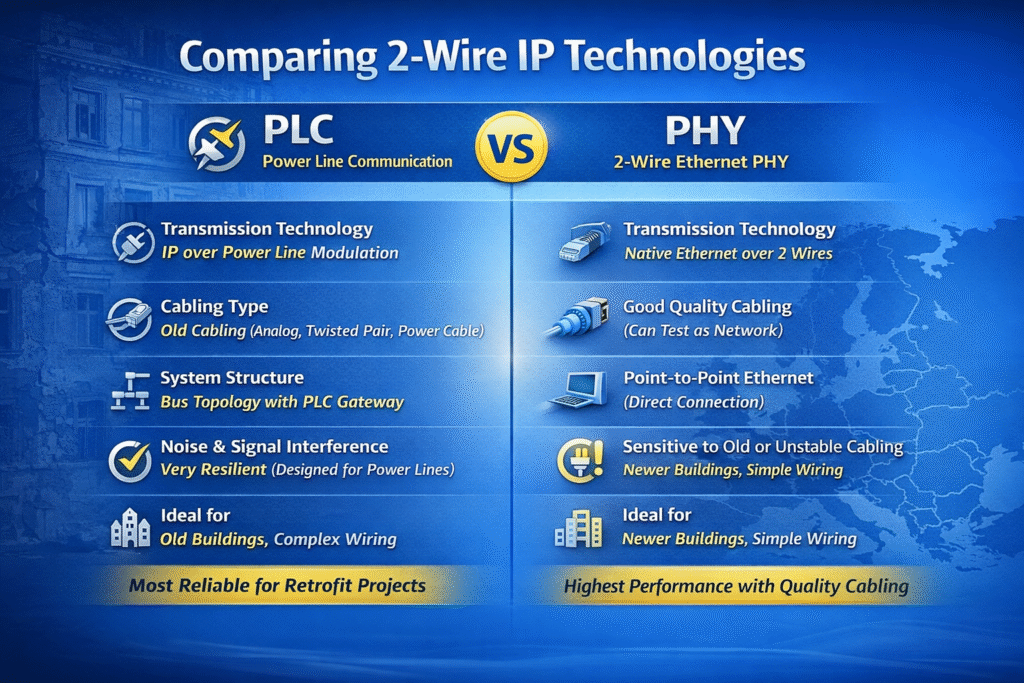
In Europe, more and more video intercom projects are moving to 2-Wire IP systems.
This is not a trend driven by marketing. It is driven by real buildings, real costs, and real installation limits.
Old apartments. Thick concrete walls. Existing cables already inside the building.
For many projects, rewiring with CAT5 or CAT6 is simply not realistic.
This is why 2-Wire IP systems have become the preferred solution for retrofit and renovation projects.
Many buyers believe that all 2-Wire IP systems are the same.
In reality, they are not.
Behind the same “2-wire” label, there are two very different technologies:
PLC and PHY. The difference between them often decides whether a project will stay stable for years—or become difficult to maintain.
Why 2-Wire IP Systems Are Becoming the First Choice in Europe?
Europe has a high percentage of existing residential buildings.
Most of them were not designed for modern IP networks.
Traditional IP intercom systems require:
- New Ethernet cables
- New conduits
- More labor time
- This means higher cost and longer installation.
A 2-Wire IP system works differently.
It allows installers to reuse existing cables, usually power lines or signal wires.
For importers, installers, and distributors, this brings clear benefits:
- Faster deployment
- Lower installation cost
- Less disruption for residents
That is why many tenders and private projects now specifically ask for 2-Wire IP solutions.
What Does “2-Wire IP Video Intercom” Really Mean?
This is an important point that often causes confusion.
A 2-Wire IP system is still an IP-based system.
It uses IP protocols, digital audio, and digital video. The only difference is the physical layer.
Instead of Ethernet cables, data and power are transmitted through two wires.
However, the way data is transmitted over those two wires is not fixed.
This is where the technology choice becomes critical.
2-Wire IP is a result.
PLC and PHY are two different paths to achieve that result.
The Industry Is Split: PLC vs PHY
Today, most 2-Wire IP systems on the market are built on one of these technologies:
- PLC (Power Line Communication)
- PHY (2-Wire Ethernet PHY)
At first glance, they look similar.
Both allow:
- IP communication over two wires
- Power and data on the same cable
- Use in retrofit projects
This is why many buyers only compare price and appearance.
But in real engineering projects, PLC and PHY behave very differently.
At First Glance, They Look the Same — Until the Project Grows
In small demonstrations or lab tests, both systems usually work.
Problems appear when the system is installed in real buildings:
- Multiple apartments
- Multiple indoor monitors
- Long cable distances
- Electrical noise
This is where the system architecture starts to matter.
The Questions Buyers and Installers Should Ask (But Often Don’t)
Before choosing a 2-Wire IP system, these questions should be asked clearly:
- Can the system support BUS wiring, or only point-to-point?
- What happens if one indoor monitor fails?
- Can devices be added later without rewiring?
- How many devices can one system realistically support?
- Does the system need converters or switches to expand?
- What is the long-term maintenance risk?
These questions are often ignored during purchasing.
They usually appear after installation, when changes are needed.
At that stage, changing the system is expensive.
Why System Architecture Matters More Than Initial Cost?
For B2B buyers, the goal is not only to finish one project.
The goal is to:
- Repeat the solution
- Scale to larger buildings
- Reduce after-sales issues
A system with a lower entry price may look attractive.
But if it cannot scale or tolerate faults, the long-term cost becomes much higher.
This is why professional buyers should look beyond product specifications and focus on:
- Network structure
- Expansion logic
- Fault tolerance
What Comes Next?
In the next article, we will move from concepts to real project behavior.
We will compare PLC and PHY in practical scenarios:
- BUS wiring vs hand-in-hand wiring
- Node failure impact
- Apartment buildings vs villa projects
- Why some systems stop at 2 or 3 devices
Understanding these differences will help you choose the right solution before problems appear.


