跳至内容
跳至内容 
It sounds simple enough to choose the right intercom system, but when you start comparing wiring types, installation realities and long-term maintenance issues, things get complicated faster than you’d expect.
Most buyers come in thinking all they need is a video intercom for the building, then suddenly they’re comparing cables, network switches, retrofit costs and scalability limits, wondering which option actually solves their problem instead of creating a new one.
What matters here is not just technology, but context, because a system that works perfectly in a new apartment project may completely fail in an old building upgrade where rewiring is expensive or even impossible.
Let’s break down 2-wire vs IP intercom options in a practical way, focusing on real installation challenges, cost impact, and long-term usability rather than just technical specifications.

Understanding the Three Intercom Types
Before choosing anything, it helps to slow down for a moment and look at how each system actually works under real-world conditions, not just on a spec sheet or in a brochure.
2-wire intercom
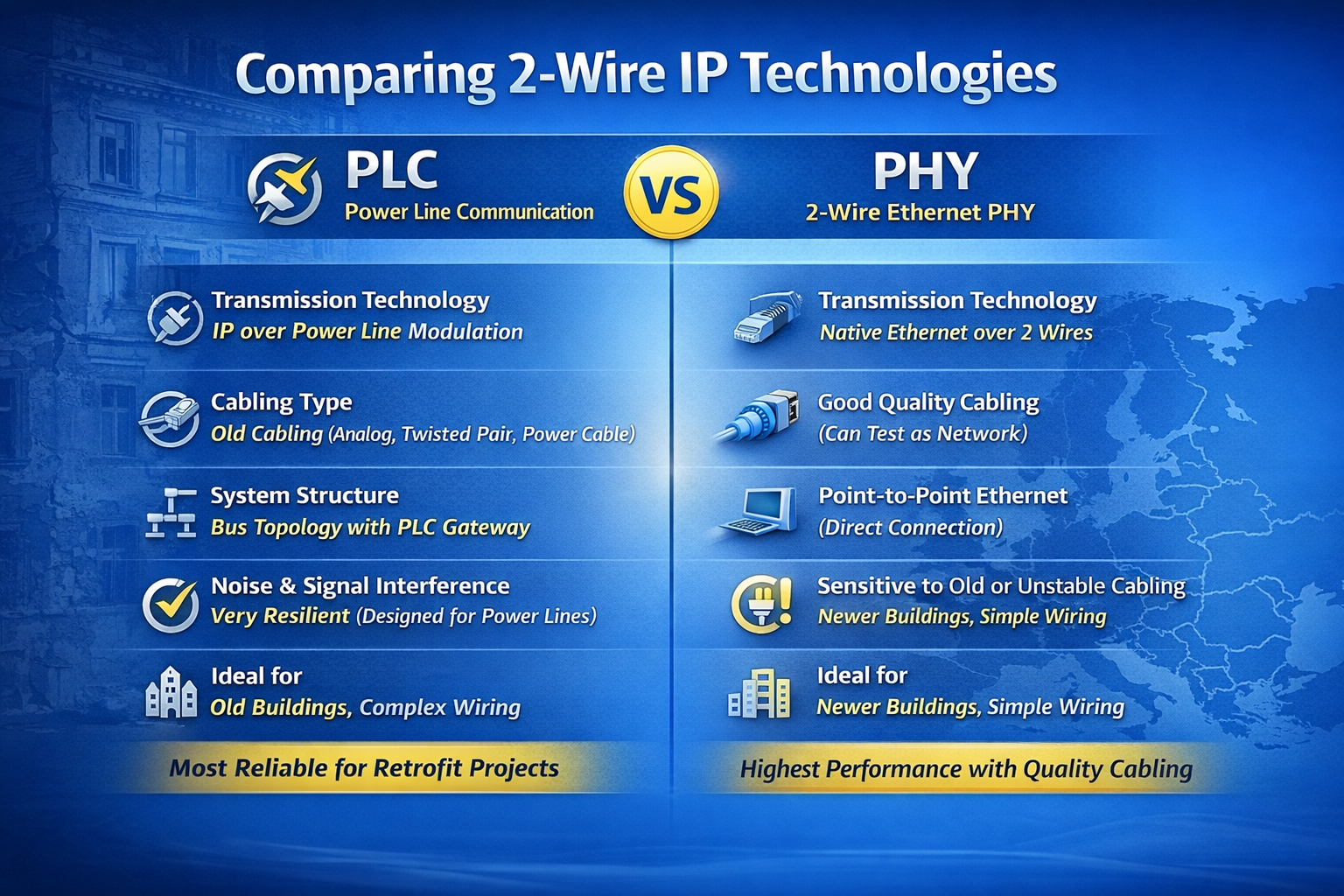
A 2-wire intercom is designed for simplicity, using only two wires to carry both power and communication, making it especially useful when working with existing infrastructure that cannot be easily replaced.
On platforms like Growinner, the system is often positioned as a retrofit solution, where installers can reuse old cables instead of opening walls or running new lines, which directly reduces labor time and project cost in a noticeable way.
This is not just a convenience feature; it can be a deciding factor in older apartment buildings, where rewiring can turn a simple upgrade into a full-scale renovation project.
4-wire intercom
If the project is simple and has no major wiring limitations, the traditional approach works in practice.
A 4-wire intercom is a little more formal, with power and signal separated into different wires for more stable performance, but it requires a little more work to install.
It is used frequently for smaller projects or villas where wiring is not a problem. It is easier to run dedicated cables during construction than after the building is occupied.
However, once installed, flexibility is limited, and expanding the system later often requires additional wiring, which increases long-term costs in ways that are not obvious at the outset.
IP intercom system
Then there is the modern direction, in which intercom systems are increasingly behaving more like connected platforms than isolated devices.
An IP intercom system operates over network infrastructure rather than traditional wiring, allowing communication, video, and access control to run over Ethernet or internet connections.
This approach transforms the intercom into part of a broader smart ecosystem, where remote access, mobile control, and integration with CCTV or access systems become standard rather than optional features.
It is often considered the most future-ready solution, but it also requires stable network infrastructure and a higher upfront investment, which may not suit every project.

Core Differences That Actually Matter
Instead of looking at features in isolation, it is more useful to see how these systems behave in real project conditions where cost, time and scalability are always pulling in different directions.
Installation and Wiring
The first real difference is often at the installation stage, sometimes immediately when work begins on site and practical limitations become apparent.
At the beginning of installation, the difference between 2-wire and 4-wire intercoms is clear, since there can be quite a difference in the amount of labour involved, depending on whether the existing wiring can be used.
A 2 wire intercom is easier to install as it works on existing wiring. A 4 wire intercom will often require new wiring and increase installation time and disruption inside the building.
An IP intercom system, however, is more about networking than wiring. The problem changes from an electrician to an IT guy. It’s not always easier, just different.
Cost Considerations
Costs seldom stay at the level of hardware pricing. This is where a lot of decisions start to change once the full picture of the project is understood.
Although the equipment may not be the most affordable, a 2-wire intercom is usually the most cost-effective option in a retrofit situation as it avoids costly rewiring.
A 4-wire intercom system may be cheap but the costs of installation may soon add up, particularly in large abuildings where cables need to be routed.
An IP-based intercom system may cost more upfront – due to network equipment – but can save money in the long run, thanks to easy scalability and management.
Scalability and Future Expansion
Not all projects remain in a fixed state, but most will change in some way, and that is where scalability becomes a critical consideration.
In the long term, scalability is a very important consideration when selecting a smart intercom system, particularly for any expanding residential or commercial projects.
A 2-wire intercom is scalable, but not to the same extent, and is best for small to mid-sized projects, and could be limited in large or complex ones.
A 4-wire intercom is the least scalable since new units may require new wiring to be installed.
This is where an IP intercom system excels, as it allows for scalability across multiple buildings or even sites with network connectivity, making it a popular choice in today’s projects.
Maintenance and System Management
Maintenance is not always a focus in the product purchase decision, but over time it significantly impacts user satisfaction with their choice of system.
A 2-wire intercom is easy to maintain because of its simplicity; with fewer parts, there are fewer things that can go wrong.
A 4-wire intercom is also stable, but can take time to troubleshoot if problems arise.
An IP intercom adds software maintenance to the mix, with software upgrades, network issues and configuration management becoming part of ongoing system operations and needing a bit more technical expertise.
Key Differences at a Glance – Comparison Overview
Before making a final decision, it helps to step back and look at all three systems side by side, because patterns become clearer when everything is in one view rather than in scattered comparisons.
| Factor | 2-Wire Intercom | 4-Wire Intercom | IP Intercom System |
| Wiring Approach | Reuses existing cables with minimal changes | Requires a dedicated multi-wire setup | Uses Ethernet or network infrastructure |
| Installation Effort | Fast, low disruption, retrofit-friendly | Moderate to high, depending on building size | Depends on network readiness and configuration |
| Total Project Cost | Lower in upgrades due to saved labor | Can increase due to wiring complexity | Higher upfront, better long-term efficiency |
| Scalability | Suitable for small to mid-size projects | Limited expansion flexibility | Highly scalable across buildings |
| Maintenance Level | Simple and predictable | Moderate with wiring troubleshooting | Advanced with network and software management |
| Ideal Use Case | Old apartments, retrofit upgrades | Villas, small standalone projects | Large buildings, smart developments |
Which System Fits Your Building Type
Even after comparison, the real answer often depends on the type of building and the flexibility the project allows during installation.
Apartment Buildings
In apartment projects, particularly older ones, choices are often made with limitations in mind, as changes and costs can be contentious.
In apartment projects, and especially older ones, the decision to choose a 2-wire or IP intercom system often boils down to cost and practicality, as rewiring hundreds of apartments is not practical.
An IP intercom system is suitable for new projects that have network infrastructure in place, whereas a 2-wire intercom can be used for renovations.
Villas and Small Projects
In general, the smaller the project, the more freedom you have, and you can choose to install various systems based on user requirements and system features.
For villas, where no special features are required, and there are no wiring issues, a 4-wire intercom can be a good choice.
But nowadays, lots of owners of small properties still like to install an IP intercom system for mobile access and smart home integration.
Retrofit Projects
Retrofit work is where things get interesting because the goal is not just to install something new but to improve what already exists without causing disruption.
When the goal is to upgrade old intercom systems with minimal disruption, a 2-wire intercom stands out as the most efficient solution.
It reduces labor, shortens installation time, and avoids structural changes, which directly translates into cost savings and faster project completion.
FAQs here
Is an IP intercom better than a 2-wire?
A 2-wire intercom is more practical for retrofit projects where you want to reuse existing wiring to reduce installation time and costs. An IP intercom system provides advanced features such as remote access and system expansion.
Can you upgrade without swapping cables?
Yes, it is possible to upgrade without replacing cables with a 2-wire intercom, as it uses the existing wiring infrastructure. This allows for a faster installation, reduced labour and minimal disruption compared to systems that require a complete rewiring.
Which system needs the least maintenance?
A 2-wire intercom is generally the easiest to maintain because it is simpler, with fewer components so less chance of failure and easier to troubleshoot than any complex network-based intercom system.
Choose the Right Technology Partner Before You Decide
At this stage, it is worth considering not just the product but also the accompanying support and solutions, as they often shape the success of the entire project.
Working with a provider like Growinner often means access to more than just hardware, including:
- Perfect suggestion for the best intercom system for an apartment building
- tailored solutions for retrofit and new building projects
- integration support for access control and security systems
- product customization based on regional requirements
- technical guidance during installation and deployment
- scalable options aligned with long-term project growth
Wrap Up
When it comes to choosing between a 2-wire intercom system, 4-wire intercom system or an IP intercom system, there’s no clear winner since each type of system will address a different problem in relation to the building type, budget and future expectations, which may not be fully understood at the outset.
If the challenge is to install an intercom system quickly and cheaply in an existing building, a 2-wire system may come as a natural solution without an overlay of complexity and cost.
For smaller, more contained projects, a 4-wire intercom can still deliver stable performance when simplicity matters more than expansion.
If future scalability, remote access, and integration are important, an IP intercom system becomes the stronger direction despite higher upfront planning.
To explore suitable solutions or request details, visit Growinner and review available options.
You can also reach out directly for project-specific guidance and a tailored recommendation based on your building requirements.